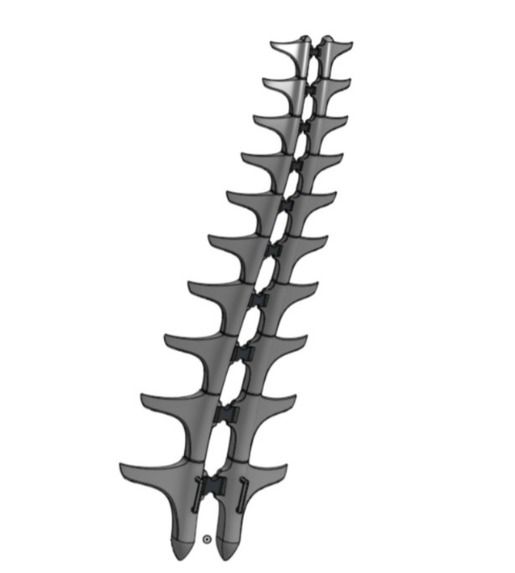
Bio-inspired modular spinal stabilization concept
Project Overview
Spinal trauma requires rapid stabilization to prevent further injury, yet conventional spinal support devices are often rigid, slow to apply, and poorly adapted to individual anatomy. This project explored a modular, adaptive spinal support system inspired by the segmented structure of the human spine.
The objective was to design a concept-level solution that balances structural support, controlled flexibility, and rapid deployment, within the constraints of a 24-hour CAD Designathon.
Design Objectives
- Enable adaptive conformity to different spinal curvatures
- Maintain alignment and rigidity for effective immobilization
- Support rapid application in emergency scenarios
- Use modular geometry for scalability and manufacturability
Mechanical Design Concept
The spinal support consists of interlocking, vertebrae-inspired segments that articulate along a central axis. Each segment contributes a small, controlled degree of motion, allowing the full assembly to conform smoothly to spinal curvature without introducing localized stress concentrations.
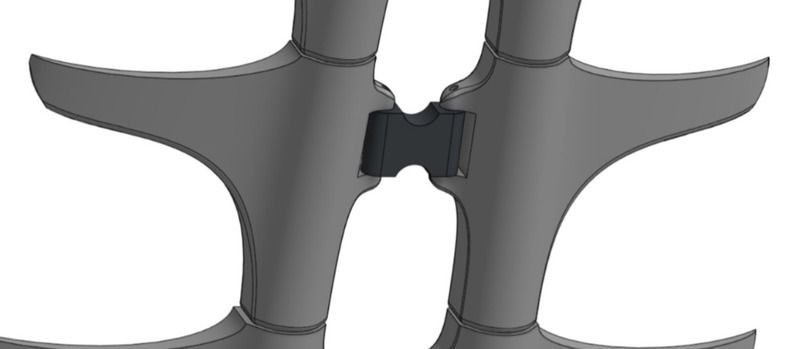
Key features:
- Repeating modular segments for length and fit customization
- Controlled articulation to prevent over-bending
- Geometry optimized for fast iteration and CAD-driven refinement
All components were modeled collaboratively in Onshape, enabling rapid iteration under tight time constraints.
Prototyping Constraints and Engineering Challenges
- Time constraint: All ideation and modeling completed within 24 hours
- Flexibility vs rigidity: Balancing adaptive motion with immobilization requirements
- Manufacturability: Maintaining simple, repeatable geometries suitable for prototyping
Iterative refinement focused on segment geometry, articulation limits, and overall assembly behavior.
Evaluation and Results
While physical testing was outside the scope of the competition, conceptual evaluation showed that the segmented structure:
- Maintained consistent curvature alignment
- Allowed smooth, distributed bending
- Preserved overall structural continuity
The design successfully demonstrated the feasibility of a bio-inspired modular approach to spinal stabilization.
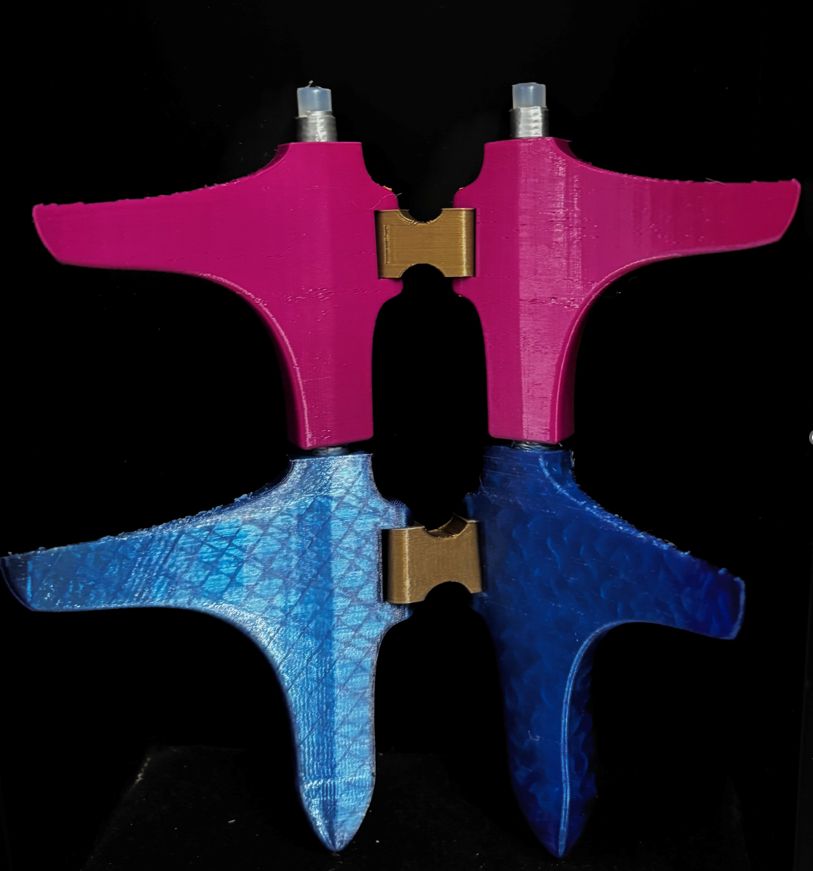
Reflection and Future Improvements
This project highlighted the effectiveness of biomimicry and modular design in medical engineering applications. Key areas for future development include:
- Material selection and stiffness optimization
- Physical prototyping and load testing
- Integration of soft-contact surfaces for patient comfort
- Rapid locking mechanisms for emergency deployment
With further refinement, the concept could evolve into a practical trauma-care device.
Tools and Skills Implemented
- Onshape (CAD)
- Biomimetic mechanical design
- Design for manufacturability
- Rapid design iteration
- Team-based engineering collaboration
 M Hasib Tabassum